Zack Anderson, the Statutory Rape Exception?

***TRIGGER WARNING**** The following may or may not trigger victims of sexual violence. The news story that follows is not meant to support sexual offenders as we know that, but to generate a conversation about the laws surrounding particular incidents involving sex.

zackandersonThis is Zack Anderson, a 19-year-old from Elkhart, Indiana who was recently placed on the Sex Offender Registry in Indiana and Michigan. Problem is, Anderson doesn’t belong on the sex offender list.

Anderson landed on this list after an encounter with a young woman he met on the dating app “Hot or Not.” The girl lived just across the state line in Michigan and posed as a 17-year-old. Anderson and the girl met and had consensual sex but afterwards it was discovered that the girl was 14-years-old which means that Anderson, unbeknownst to him in the moment, committed statutory rape. (Statutory rape laws in Michigan state that, “Third-degree criminal sexual conduct is sexual penetration with someone between age 13 and 16.” Statutory rape laws for Indiana state that, “Sexual misconduct with a minor if a person at least age 18 engages in sexual intercourse with a child between ages 14 and 16.”)

Now Anderson faces a 90-day jail sentence, five years probation and placed on both Indiana and Michigan’s sex offender registry for the next 25 years. The girl and her parents attended his court date and declared that he shouldn’t be punished for her wrongdoing but the law remains. To top it off, the judge expressed disdain for the fact that Anderson used the Internet to meet girls saying, “That seems to be part of our culture now. “Meet, have sex, hook up, sayonara. Totally inappropriate behavior. There is no excuse for this whatsoever.” Those of us who use the Internet to connect, platonic and romantically, know that there is more than an excuse, there is a reason for this method of communication and meeting, but that is neither here nor there at the moment and the judge probably could have withheld his opinion on that. The real issue at hand is what to do in a statutory rape case when your victim lies and she–or he–comes forward to confess that lie and there is evidence of that lie–in this case maybe there is evidence through archived webpages of her dating profile that show her misrepresenting herself and her age.

Lying about one’s age on a dating app is an occurrence as old as time. So what are the consequences for lying about one’s age in a situation that could do harm and damage to the other person’s life? (And really, though Anderson is the only one being explicitly punished, I’m willing to bet that the girl may endure another kind of punishment if only through guilt.)

Nevertheless, because of this young woman’s lie Anderson’s life will never be the same. He has the jail sentence, the probation, the sex offender registry, and he can’t live or go near his parent’s house because he has a 15-year-old brother all because of a lie. I’ve been wracking my brain to see how this might be justified but I just don’t see it. Even as I write this I’m thinking, “But what if this is all I setup? What if his parents paid hers to come forward and state that she lied?” On one hand I want to believe this young man’s account because I want to believe that not every young man is a factory of raging hormones looking for a release by any means necessary–a nod to a Camille Paglia. On the other hand I’m fully aware that with our culture, a culture where rape culture is persistent and men get away with all manner of evil while we either silence or shame the women involved, the alternative storyline that I’ve conjured in my mind could also be possible. But I want to look at this case considering the evidence we have before us which is, literally, the testimony of Anderson and the girl’s admission and apology.

Say we take Anderson’s account at face value as well as the confession of the girl.

Say all of it is true.

Should the statutory rape law be upheld? Why?

Should there be an exception to the law if the victim confesses to deceitful behavior?

Should the victim be punished? Why? How? 

I’m very curious to hear perspectives across the board.

In a few days I’d like to follow-up on a few other issues that I can’t yet cover in this post which will include results from the questions above as well as the poll attached and why I am actually against the sex offender list in general. Until then, I look forward to sharing dialogue with people on the present case.
#TheEmptyChair: The Numbers Behind NY Mag’s Cosby Accuser Cover

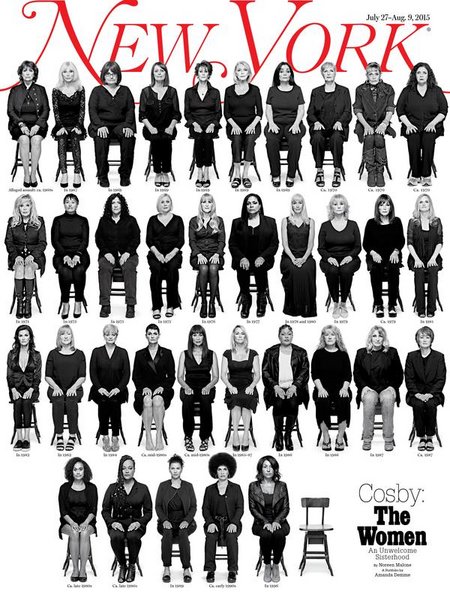
cosby-nymag-cover-1Last night the cover for New York magazine’s issue featuring the stories of 35 of the women raped by Bill Cosby dropped and it left many, myself included, shaken to our cores. The black & white cover, pictured below, features the 35 women and an empty chair symbolic of the women who have yet to come forward. I only read two of the accounts before turning away from it because it was just too heavy but I couldn’t escape it as #TheEmptyChair became a trending discussion on Twitter last night.

There are so many empty chairs. Not only the empty chairs in the Cosby situation but empty chairs in general for the countless number of women who have yet to come forward, report their rape, and share their story. To put some weight on an already heavy story I’d like to share some numbers that, once I saw them, I could not unsee them.

A Department of Justice report on rape indicates that for every white woman who reports her rape, five don’t and for every black woman who reports her rape, 15 don’t. Taking those numbers and applying them to this cover to determine the potential number of empty chairs we would end up with approximately 220 empty chairs. That’s 220 unreported incidents of sexual violence against women. 220 stories never told. 220 women still bound by their captors even though their captors have long left them. The trauma that women face after sexual violence remains with them long after their abusers have left the side of the bed, room, the dark alley, the bathroom, and every other domain where sexual violence occurs. Even a story told does not remove the memory and the trauma but for those who are brave enough to come forward it starts them on the process toward healing. But there are at least 220 empty chairs out there that may never be filled which means there are women who may never find any semblance of peace, healing, and wholeness. Though we can proclaim that they are not what happened to them it is what happened to them that is keeping them silent.

It is my hope that women who have yet to sit in the chair will be encouraged not only by the 34 women on this week’s cover but that they will also be encouraged by the scores of people, myself included, who believe and support them. Even though I don’t see you, I want you to know that you are seen. Even though you haven’t spoken, I hear you. Until then, I pray for peace in the midst of this storm and for your courage to come forward at the right time for you. Know that there is no statute of limitation on your freedom and recovery so whenever you do come forward–whether within the ridiculous limits of our legal system or not–freedom and wholeness are there for the taking. Also, until then:

And for those of you have who have come forward, particularly those who were courageous enough to come out on the cover, I will honor you and read your story. Thank you for your courage.

Bill Cosby, Christian Silence, and Rape Culture Perpetuation

Recently I was in search of inspiration and I needed to start my day with a word of inspiration or at least a couple of good songs. So I turned to the local gospel station to find the Yolanda Adams Morning Show in full swing. Adams, like many over the past few days, talked about Bill Cosby’s deposition, in which he confessed to purchasing drugs to drug women for sex. Adams, instead of talking about how problematic Cosby’s action were, asked why a woman would go to a married man’s hotel room. She tried to deflect by saying that she wasn’t condoning what Cosby did but that it still remains that the women shouldn’t have visited the room of a married man in the first place. Following her comment others on the show chimed in to talk about what they felt were the missing pieces in the situation and one man even remarked about how, when he saw Bill Cosby’s stand-up routine years ago, he was just so inspiration. After they finished bloviating they moved on and so did I. My hope for inspiration was dashed away by everything they didn’t say and so I turned my attention elsewhere, specifically to Big Sean’s “Dark Sky Paradise.”

I didn’t turn on the radio to hear what Yolanda Adams and friends had to say about Bill Cosby but since they decided to speak, I hoped they would speak correctly about the situation. I haven’t even talked much, publicly, about Cosby because I’ve been trying to figure out if it’s an expedient use of my time and voice. But as the days wear on and more information is revealed and I see how people are processing it, I realize that I can’t remain silent. I can’t remain silent because there are so many women who remain silent and even now their silence is being eclipsed by those who choose not to see situations, such as the one we are currently watching unfold with Cosby, as a cause for concern. Silence is a huge part of the issue of hand with Cosby, scores of sexual abusers, and the abused.

When you do a search for Christian websites who have covered the latest news on the Cosby situation you come up with nothing. They aren’t talking about the fact that he confessed to purchasing the drugs; they aren’t talking about the fact that he used the drugs and his power to sexually abuse women; they aren’t talking about the problem with the people who, only now, believe he raped the women because of the deposition; they aren’t talking about anything. Yet, these same sites that are quick to talk about the implication of the SCOTUS’s same-sex marriage ruling. They are also the same sites that publish endless articles about pre-marital sex and other people’s sex and sexuality, but given the opportunity to talk about sexual violence they remain silent on the issue more often than not. They fail to realize that sex is an issue of social justice  which means that sexual abuse is a stifling of that justice. Christian silence on the matter suggests that the only sex we ought to care about is consensual sex between married and unmarried people or non-consensual sex between pastoral authority figures and those under their care; i.e. Catholic priests, youth pastors, senior pastors, and others in roles of power. Yes I said it. There’s no problem publishing articles on these men, but usually in doing this, the women, the victims, are left behind. Christian silence on Cosby, also suggests that maintaining the pristine image of the fictional figure of Cosby in American consciousness deserves more attention than the heinous crimes he committed.

I’ve heard some people remark about the loss of one of America’s greatest father figures and, as most of us know, Cosby’s confession has led to several networks pulling “Cosby” and “The Cosby Show” off the air. My problem with this is that it isn’t important in the grand scheme of things. I will suffer the loss of a fictional figure if it means that, in reality, a woman gains her wholeness back. Since the allegations against Cosby started, many questioned his victims accounts. I’d be remiss if I didn’t confess that, initially, I was skeptical about the veracity of the multiple victims’s claims. I understand that for many it was hard to believe that our fictional father, the lover of Jell-O pudding pops, the funny guy with the ugly sweaters, was guilty of raping countless women. He has lived as a moral exemplar in our consciousness for so long–for at least as long as I’ve been on this earth. So, for at least 34 years, Bill Cosby has been a moral exemplar for dads all over the world and his family has been the template for every wannabe perfect black family.

So I get it, given this it was hard to strip him of his illustrious title when the allegations broke. But this is also the problem with our culture, we exalt public figures to god-like status and sometimes conflate their fictional selves with their actual selves if they’ve graced our television screens for long enough to leave a mark.

(SN regarding the show: What we ought to grieve, if we grieve anything connected to the show, is the fact that people are so blithely unaware of the affirmation of patriarchal values implied in taking the show off the air. By this I am suggesting that taking the show off the air communicates that the most important person on the show was Bill Cosby/Cliff Huxtable and it discounts the power and value of the influential female leads. Personally I learned a whole lot more from Claire than I did Cliff, so I hate the idea of killing Claire with Cliff. I believe her legacy in black consciousness is just as strong and worth keeping the show in syndication.)

Back to the lecture at hand: To grieve the loss of Cosby the fictional dad before you part your lips to say a word about the matter of rape culture that pervades this entire situation is to idolize the man and sin against your brother and your sister. The idol must be destroyed and the people, the victims, must be built up. But first, people have to admit that rape culture is the most important issue at hand here and that it must be talked about.

A few people got the Cosby story right by calling it what it is, “Rape Culture.” In this context rape culture is, as public intellectual Marc Lamont Hill states, “NEEDING Cosby to admit he’s guilty before we believe it.” Rape culture is more news headlines saying nothing about rape in their coverage of the Cosby case. Rape culture is putting a statute of limitation on the amount of time a woman has to report her sexual assault before no legal action can be taken or it won’t be taken seriously. Rape culture is every action that gives more power, even if only rhetorical, to the rapist over caring for the victim. And finally, rape culture is every Christian who is silent on this or thinks that the discussion of rape culture within the context of Cosby case is a distraction. I’m here to say it is far from a distraction if you consider the sheer volume of sexually abused bodies that line church pews Sunday after Sunday. Given this, talking about Bill Cosby without talking about rape culture is the real distraction. And continuing to be silent and/or talk about the wrong thing in cases like these will only serve to further wound the wounded.

A Not So Sweet Spot: Questioning the Performance of Sexual Liberation

Note: The following post has strong sexual language and content. 

This weekend I had the opportunity to attend Sweet Spot, an evening of “high energy, heart pumping, fist pounding, laugh out loud pop erotica performance art.” The evening featured spoken word artists, singers, burlesque dancers, a sexologist, comedians, a miniature sex toy shop and much more all focused on one thing, sex and the acquisition of pleasure. I must admit that from the onset I was hesitant about attending this particularly after I watched a promo video for it. It looked like it was above my sexual pay grade and like it would be filled with moments that would make me clutch and break my non-existent pearls. It turned out that it wasn’t above my sexual pay grade, it was–in my opinion–beneath me and did a particular kind of violence.

The show started out innocently enough with some jokes, a pledge that included putting our hands over our “hearts”–hearts defined as private parts–and the rules of engagement otherwise known as “How Not to Cockblock Yourself.” The host for the evening, a petite young woman wearing a bedazzled ringmaster costume, told the women that the two ways we cockblock ourselves is sitting with either our arms or legs crossed. She directed us to uncross both and allow our “hearts” to breathe and be free. I appreciated this opener for no other reason than it was clever, not for its ability to help a room full of men and women keep their legs open for whatever may come. What followed the opener was a series of performances which started with a woman reading erotic fiction. I’ve never read erotic fiction, so it was interesting to listen to someone do a dramatic reading. It was also the moment when I realized that “dick” and “pussy” were the only words I would hear for the next few hours and it felt like an assault each time I heard it. This was the beginning of what I felt like was a particular kind of violence. But I tried to suspend that judgement until I saw more.

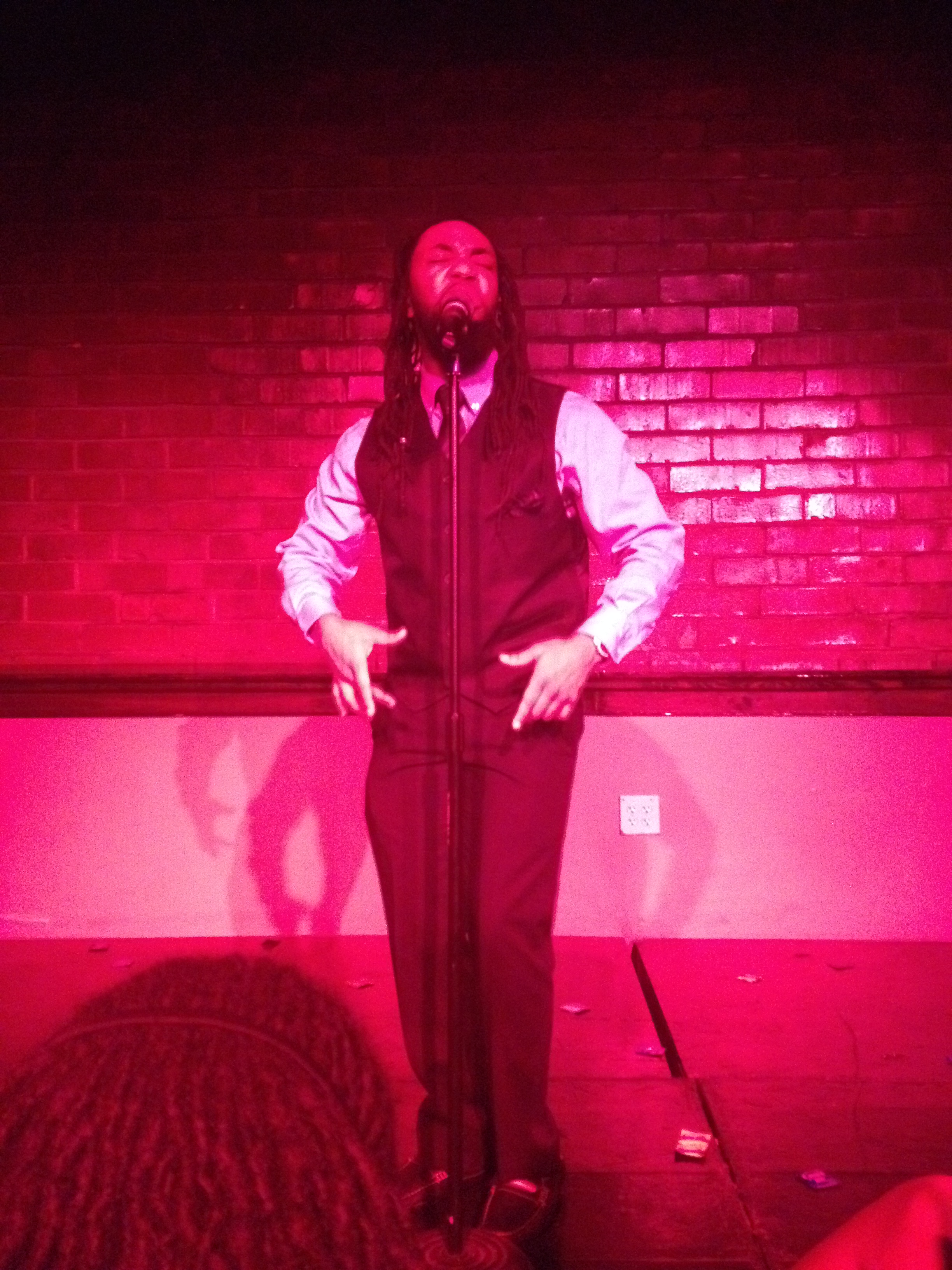
sweetspotphoto

The son of a preacher man reciting erotic poetry–and I’m not talking about Songs of Songs either.

The show continued with a burlesque dancer from Jamaica who was actually pretty good and had the most amazing back tattoo I’d ever seen, so that was a moment of reprieve. After her were two spoken word artists, the first was the son of a preacher reading from, “Fellatio 3:16.” I’m sure you can imagine my shock at the title but that was just the beginning of the profane as he said things such as,

I will read a scripture off your clit.
You can suck Lazarus back to life.

The violence of those words struck me particularly because I am a Christian woman. I understand it was the play on words given his context and upbringing, but I couldn’t help but be bothered. He invoked the homiletic style of charismatic black preachers to get the crowd riled up and aroused, but, to me, it just felt profane and reckless. I teetered between a dropped jaw and nervous laughter, and trying to find something redemptive about what I was hearing.

Another spoken word piece was performed by Sweet Spot Nation founder, Ainsley Burrows, and featured yet more lust-filled allusions such as,

I will eat the magnesium out your cum
I’ve got enough dick to raise your IQ and make you lower your standards at the same damn time.

His performance was slightly more invasive because he stared me and my friend down intently during moments in his routine.  By this time my reactions were part laughter, part silence, and part observing everyone around me to see their reactions.

In the midst of all of this there was also the condom throwing that was off-putting. Yes, condom throwing. A multi-pack of condoms and lubricants sponsored by the Stand Up 2 HIV Atlanta campaign was provided for each seated guest. I thought it was a nice touch for the evening given the public health concern that HIV is within urban cities such as Atlanta. But at no point in my time there–it could have happened after I left–did I hear a plug for the program or even gratitude for contributing the condom gift bags. Instead I saw many of the condoms being thrown at the artists and performers as if it were a form of currency. I was disappointed, to say the least, in the extreme waste of an important resource in the fight against HIV.

Though I’ve mentioned my feelings about the violence instigated through language throughout the night, it actually didn’t occur to me what was taking place until a sexologist hit the stage halfway through the show. She focused on teaching women and men how to get and give the best possible orgasm and she claimed that many don’t get there because of the aggressive nature in which some approach the sexual event. She encouraged men to take their time with women instead of acting like attack dogs and encouraged all to acknowledge the sensitive and delicate nature of our sexual organs and told women to breathe. But it was the juxtaposition of hearing someone talk about how we should be more gentle and patient in sex while hearing coarse, abrasive language that made me realize the entire situation was troubling and mimicked a particular kind of violence.

So what is this violence? I believe that violence is not just in the realm of the physical, it can be verbal and mental. Thus when I speak of the violence at Sweet Spot, it was violence through speech and through making the sacred profane. Whether it was through using Scripture as a template to talk dirty or language that made sex seem like one long rough porn fantasy, I wasn’t convinced of any sexual liberation.

As a culture we’ve long struggled for and against sexual liberation for years. Those who have fought for it are the pioneers and offspring of the sexual revolution. Those against it have primarily been conservative Christians. I want to clarify that though I am Christian–I consider myself progressive–I am not opposed to sexual liberation. I am, however, opposed to sexual liberation that results in uncritical ways of being sexual. I believe in responsible freedom which still requires some limitations and reflection on what is expedient. As it pertains to sex and sexuality narratives, I’m interested in what repeated narratives do and how they form and/or inform us. So, in the case of my time at the Sweet Spot where I was assailed by coarse language–and flying condoms, I wondered what that language did to people. How that language might have been the reason that men attack women in the sexual act–I’m not talking about rape here but the aggressive way that some men descend upon women in the sexual event because they heard that is the way. I thought about what it means to be a black person whose sexuality has almost always been regarded as animalistic and aggressive and I wondered if words such as “dick” and “pussy” play into that or are they part of our culture’s way of expressing ourselves sexually. Are the words our own or did we get them from someone else who is still determining our sexual selves? Are there different ways of speaking about sex that don’t rely on an allusion to violence? (Think about the popularity of the phrase, “I’ll beat the pussy up” in urban music.)

There are so many questions that came out of my Sweet Spot experience that made me wonder if the artists and audience were truly sexually liberated or sexually oppressed and just performing an idea of liberation. And of course the question of whether I’m the sexually oppressed or repressed person is up for discussion too. That is another reflection I’m taking up, but that is also much too predictable a conclusion to draw at this point. It’s too easy to say that the person who walks away from an event such as the Sweet Spot feeling anything but aroused and liberated is sexually repressed. It doesn’t leave room for a critique that could be useful to all parties involved. This is not to disregard pop erotica as a genre, but it is to stretch our understandings of the genre’s form and function in our communities, psyches, and selves.

PS: Lest anyone read this and think I had a completely bad experience I did enjoy myself during the break between acts when they played a lot of ratchet Top 40 music and, like I mentioned earlier, the burlesque performer and her awesome back tattoo was great too. Maybe my next excursion should be to a burlesque show.