On Second Thought, Selma Was Snubbed

On MLK Day I finally had an opportunity to see “Selma.” Yes, my last post on this blog was that “Selma” wasn’t snubbed and I wrote it having not seen the movie and I don’t regret it. I didn’t write it as someone who believed the movie wasn’t good, I knew “Selma” was good from the moment I saw the trailer during a “Scandal” commercial break on November 6. So when the Oscar nominations came and went with “Selma” only being nominated in two categories I really just felt it was par for the course. I honestly don’t expect the academy to rally around us every year–sad but true–and feel like they think they gave us our glory last year and we’ll have to wait another few years–also sad but probably true. But now that I’ve seen and felt “Selma” I do believe it was snubbed. Why?

1. It wasted no time. The first five minutes of the film alone made it worth a direction and cinematography nomination. To move from the calm of Dr. Martin Luther King Jr. accepting his Nobel Peace Prize and then cut to the chaos of little girls bodies drifting in the back draft of a church explosion was an incredible feat. It was not only visually arresting but it was emotionally gripping. How quickly those little girls went from wishing for hair like Coretta’s to meeting their maker. Reality struck. The moment thrusts viewers into the narrative arc of the film and of history establishing that in the midst of seeming moments of calm there is chaos somewhere and this should set us on edge. DuVernay wasted no time.

2. “Selma” gave us a look at the march from several different angles without ever seeming aimless and disjointed. We saw the story from the perspective of King and the SCLC, SNCC, Lyndon B. Johnson, Gov. Wallace, and the media. I may be missing a few other perspectives but, suffice to say, the view of all of the aforementioned provided for a multilayered understanding of the issues at hand for all involved. It did all of this without being heavy-handed, losing focus, or confusing the viewer. There are times when a film seeks to do too much and it shows, but it never showed in “Selma.”
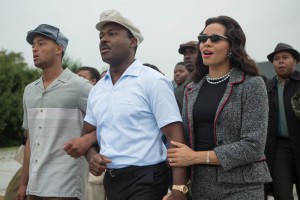
123.The casting was FLAWLESS. Carmen Ejogo was the best choice to play Coretta. From the minute she graced the screen in the beautiful beaded appliqué gown with her hair precisely coiffed to match the late Coretta Scott King’s, I felt that I was undoubtedly looking at a holographic image of young Coretta. But it’s not just that Ejogo looked like Coretta but that she embodied her presence. Coretta Scott King was regal. She could say much or little, but I imagine that when she walked into a room she commanded attention. Ejogo did that. Her words were few but her presence spoke volumes. But Ejogo wasn’t the only casting gold. Of course we all know that David Oyelowo as Martin was perfect in looks–despite his being a touch darker than Martin–and embodiment. Other perfect casting included Bayard Rustin played by Ruben Santiago-Hudson, James Bevel played by Common, and Andrew Young played by Andre Holland. The casting is not only about the look but the embodiment and in a movie of this nature, embodiment is key. Most, if not all, of the actors were able to become their roles to the point where you forgot who they were in reality. That is the key to great casting.

4. It took the audience somewhere. I concluded my previous post on “Selma” by stating that the film convicting and moving people is an award in itself. As I watched it I was sitting between two men. A white man I didn’t know on my left and my friend, a black man from Alabama, on my right. I cannot deny the tension I felt during the film, having moments where at once my internal voice said, “I hate white people,” while wanting to hold my friend’s hand and/or rest my head on his shoulder because I was so overcome with emotion. (To be clear, I don’t hate white people I hate their privilege and their failure to recognize that they have it whether they want it or not because of the color of their skin.) DuVernay’s depiction of “Bloody Sunday” set the movie theatre on edge. I looked around and saw the man on my left wincing and wiping away his tears, my friend on the right with his hands clasped in front of his face, and many others throughout the movie theatre watching in a state of shock and sadness. The movie did and is doing affective work inside and outside of the theatre and that, I believe, should be considered among one of the highest virtues of film viewing.

5. Black people were the heroes. Often it feels like it is easier to nominate a black person for an Academy Award when they are driving a white woman around, playing a corrupt cop, begging a white man to “make me feel good,” being a crazy dictator, a slave, and the list goes on. This is not to say that we haven’t been nominated for playing other roles, but more of the roles we are nominated for and win are the roles that find us either under someone or being over someone in the most animalistic way possible. Though Martin Luther King, Jr. is not without faults, he broke some ground for us and the narrative of his work continues to make ways for us–I will not get into the issue with the problem of the narrative right now. All of this to say that to see David Oyelowo and Carmen Ejogo clench the nomination for best actor/actress would have been a welcome respite from many years of being nominated for the same types of roles. I would prefer to see a King awarded over a Sniper.

So what now?
no_oscarI am a loyal viewer of the Academy Awards with a longstanding tradition of live updating during the show but this year I will not watch, tweet, or do anything that supports the Academy Awards because they don’t support me.  Do you realize how many white narratives the Academy has supported over the years? Sure some of those narratives were worth the awards but year after year that show is always more liable to stick to its own–even when their own does mediocre work at best rather than considering anyone else. And that’s the thing, why should our stories not be theirs too? Why must we be “othered” even when we are in the same industry? Their stories are told and credited as worthy of numerous accolades while we are lucky if we are nominated. More of us than not support their stories in addition to our own while they continue to just support their stories. Something’s got to give.

#nooscars

Selma Wasn’t Snubbed, It Just Is What It Is

Academy Award nominations were announced this morning and with it came headlines that Ava DuVernay’s “Selma” was snubbed. Before I knew of what and who was nominated I knew that “Selma” was snubbed so I nearly assumed that the movie didn’t get any nominations, yet that wasn’t the case. “Selma” received two nominations, one for Best Picture and another for Best Original Song. This is still significant and it looks like DuVernay thought enough of the nominations to symbolically gift them to the late Dr. Martin Luther King, Jr. on his birthday.

Alas, everyone else is on the snubbed life and up in arms, but I wonder if this is the reaction we need for something that is par for the course. My title says, “It is what it is,” which is what I say when I decide to just accept something as it is.

2012 demographics of the Academy of Motion Picture Arts & Sciences

More often than not black films, actors, directors, etc are snubbed more than they are nominated. It is to be expected given the demographics of  organizations such as the Academy of Motion Picture Arts & Sciences. An organization that, despite its black female president Cheryl Boone Isaacs, boasts a predominantly white and over age 60 while male voting membership. It is what it is. Thus it makes me wonder if we need to stop looking for approval by way of these white men and their awards and just affirm ourselves–and also not snub the value of awards that come from black organizations such as the NAACP Image Awards and the like. Popular opinion–also usually the opinion of white people in positions of power–would have it that a nomination and award from the Hollywood Foreign Press and/or AMPAS is proof that we’ve arrived, but to set our sights on that approval as a sign of achievement is a disservice to ourselves. Reality is, we don’t need a Golden Globe or an Academy Award to know that we’ve arrived and done well. And we have to stop hoping for “them” to pat us on the back for telling our own stories. We are worth more than a piece of globe or man-shaped gold. We are history makers and we never needed an award to be the pioneers that we are.

Making history is what we do. We’ve gone from the people who were the victims in history to the people who are slowly carving out victory status in history–even while we are yet still victims. Whether we are making history for turning a hashtag into a movement that declares the value of black lives or because we directed great actors and actresses to retell our history through cinematic re-interpretation, we’ve never needed an award to advance and make known the power of our voices. Who we are seeking recognition from has to change.

10868235_10152520930666394_8485591587477188255_n

As a close friend said this morning, “Winning. #thatsall”

We don’t have another moment to hope someone will nominate us or throw us an award for work we already know is good. Not another moment to speak of a “snub,” how white the Oscar will be this year, how discriminatory the academy may be, nothing. I say this because I’m tired of us waiting for someone to acknowledge our greatness when it has always been inside us. We don’t need anyone to give us an award to know we are good. We may want the award but we really don’t need it and it really shouldn’t change anything in a world where the scales are rarely tipped in our favor. The biggest mistake we can make nowadays is to be fooled into believing we’ve been snubbed because the collective “they” didn’t recognize us. We aren’t being snubbed, they are snubbing themselves in failing to acknowledge us. We lose nothing, they are the ones missing out. “Selma” was not snubbed because no value was taken away from the film in not getting an Academy Award nomination. Ava DuVernay was doing incredible work before the Hollywood Foreign Press and AMPAS ever thought to nominate her and she will continue to do incredible work. The same goes for David Oyelowo, Carmen Ejogo, Oprah Winfrey, et al.

The greatness of our work doesn’t hinge on its acceptance by some board of old white men but in our confidence in our own work and its power to teach and transform our own community. I’ve seen more people talk about how “Selma” has convicted and moved them to action than anything else and I think that’s the best award.

Je Suis Charlie Ain’t For Me But Nigeria Is

10592895_10155009078450577_5934096020306985616_n

Last night I was about to go to bed when I noticed the image above posted on a friend’s Facebook page. I had just finished watching the Golden Globes for three hours and heard more white people evoke the clarion call of the moment “Je suis Charlie” than I heard them even so much as imply that “Black Lives Matter.” The latter is the prevailing topic of our days and “Je suis Charlie” just came into our consciousness about a week ago. It seemed to me that this would have been a key moment for this group to show their solidarity but instead they showed that they are more concerned about ensuring the right to free speech even when it borders on being racist and offensive to their fellow brothers and sisters than they are in protecting the lives of those same brothers and sisters. So last night the fight for freedom of speech and expression won over making true the allegedly self-evident truth, that “all men are created equal, that they are endowed by their Creator with certain unalienable rights, that among these are life, liberty and the pursuit of happiness.”

I’ve yet to post “Je suis Charlie” anywhere for a variety of reasons not limited to being unsure that the campaign is one I need to get behind before I pump my fist more powerfully in the direction of fighting for the rights of my own who are slaughtered daily. I don’t feel compelled to say, “Je suis Charlie” because it feels like the call of those who’ve always known the privilege of freedom, such as the freedom to draw potentially racist and offensive pictures and call it entertainment. I don’t know that freedom. I know more about what it means to be the satirical cartoonist’s subject than I do to be the cartoonist. I am not free to draw. It is for that reason that I cannot, with any sense of confidence, say “Je suis Charlie.” I cannot say “Je suis Charlie” in the midst of the injustices taking place in my own backyard that are based on the harsh, unjust lived experience of being black in America. And surely I can’t part my lips to say “Je suis Charlie” when just this weekend Nigeria experienced its deadliest massacre at the hands of Boko Haram. 2,000 innocent children, women, and elderly people were allegedly massacred and now there is news of children being used as suicide bombers by the organization. Nigeria, where over 200 girls were kidnapped last year and we still don’t have them all back. How can I get behind #jesuischarlie when #bringbackourgirls and #blacklivesmatter are still at large? My brothers and sisters cannot decide not be black one day but the cartoonist and the writer can decide to use their gift differently. This is why “Je suis Charlie” ain’t for me.

My responsibility is to my people. This is not to dismiss of the importance of the lives lost in Paris or those putting themselves on the front lines to protest for a freedom–not freedom but one kind of freedom, but I acknowledge that the fight for fundamental freedom in my own backyard weighs more heavily upon me. Boiled down this is about the pen versus personhood, and even though I’m a writer my blackness compels me to the fight that I see as more essential to ensure more of my people live to see another day.

I am more Naija than I am Charlie.

I am more captive than I am free.

I am more subject of derision than I am master.

I am not Charlie.

Je ne suis pas Charlie.

As for me and my house, I will be praying for Nigeria. 

#prayforNigeria

Defending “Descent”: On Cinematic Rape and Retribution

Disclaimer: One, SPOILER ALERT: The conclusion of Descent starring Rosario Dawson is given away here so if you’d prefer not to have this spoiler you may want look away now, but I encourage you stay for it is that conclusion which paves the way for my broader analysis. Two, TRIGGER ALERT: This post touches on the topic of rape which may be touchy subject for some because of their direct or indirect experience with this form of violence. I encourage you–if you can–to stay and read and add voice to this discussion so that it may be full and not lacking in perspective. Three, this post was from a year and a half ago but my perspective on the matter still remains, for the most part. Thank you for reading.

This weekend I watched a man get raped by another man and I couldn’t take my eyes off of it. It was in a film entitled Descent in which Rosario Dawson plays a college woman who gets raped by a man whom she thought was a potential suitor and exacts revenge by planning for the perpetrator to get raped by another man. I watched the film with a close male friend whom, during the rape scene between the two men, turned  to look at me a several times and each time my eyes were glued to the screen. He couldn’t draw my attention away from it. It was 10 minutes of violent thrusting, name-calling, and shaming and I could not be moved to either talk about how excessive it might have been or turn it off all together. After the film was over I sat on my couch in silence with my eyes still hooked on the television screen. My heart was beating quickly and my mind was running a million miles per minute. My friend commented on how excessive he thought the rape scene was and all I could remember saying is that it made sense. He repeated that he felt it was excessive for the film and still I repeated, “It makes sense.”

My logic throughout the 10 minute rape scene and in conversation with my friend was that for decades we have watched women get raped in film and on television. I watched Kristy Swanson’s character Kristen get raped in John Singleton’s college campus drama Higher Learning. In the second season of a Different World Freddie Brooks almost gets raped by her date Garth Parks. I watched Buffy almost get raped by Spike. In Gossip Girl I watched Chuck Bass attempt to rape two women in one episode. In For Colored Girls Only, Yasmine/Yellow gets raped by a man whom she thought was a potential suitor. There is the rape scene in Stanley Kubrick’s Clockwork Orange which is edited out in most versions. I also hear that there is a rape scene in The Girl with the Dragon Tattoo in which the main female character gets raped through sodomy. When I saw each of these movies or television shows I didn’t anticipate having to sit through a rape scene, but alas I did. And sadly, these movies don’t add up to even half of the movies with rape scenes in them.

Countless are the movies and television shows in which women get raped or are in another way sexually assaulted. As a woman, I am almost too used seeing other women get defiled in the media either through the dramatic portrayal of rape, sexual assault, or through the popular coerced or voluntary objectification of women in music videos. But when I watched the rape revenge in Descent I felt something. Maybe it was redemption for all the years of women being raped in cinema and real life. To be clear, I don’t believe in this type of personal retributive justice, because in the end it most likely will not resolve anything. This is illustrated in Descent‘s final scene as Dawson turns toward the man raping her assailant and, with tears in her eyes, silently conveys that this is no revenge at all. One reviewer of the movie, called it a demagogic feminist exploitation revenge drama, but to do so is to misunderstand the project of feminism which is not employed well in this film. For it to be a true demagogic feminist exploitation revenge, the movie would not end with the man in power but would end with Dawson’s character reclaiming herself. I believe the true feminist revenge is to not let rape define and shape you into anything other than a woman who reclaims herself–but maybe I have just been reading too much Camille Paglia and the movie does indeed represent feminist revenge.

But, lest I get too far away from my original point, I do think watching that scene, unwilling to turn my eyes away from it, made me much more certain that personal retributive justice is not what I believe in. I derived no pleasure from the scene but in refusing to take my eyes off of it, even when my friend tried to divert me, was me implicitly saying, “Sit through this, get comfortable with it,” because I have gotten comfortable with rape over the years. And yes, I admit that is part of this, that I wanted a male to sit through a scene of another male getting raped without averting his gaze, I wanted him to be comfortable with it. The day after I asked my friend if his maleness affected his ability to accept the prolonged rape scene to which he said it didn’t, he just believes that it was excessive in film and not right in reality. We also had a conversation about the possibility of females being a little more open to watching it unhindered because it could serve as cinematic redemption to the pervasive rape culture. We have no answer to the aforementioned query.

So maybe my reaction was my own and not representative of what many women might find agreeable, but I am curious to know if there are any women or men out there who may find this type of revenge dramatically portrayed helpful or harmful to rape culture as we know it? If you have seen Descent what might you suggest as an alternative ending? If you are a feminist or a womanist–because I can’t neglect that a part of this film was the power dynamic between this white man and Dawson’s “ethnically ambiguous” self which he insulted during the rape–what is your response to this film? And, generally speaking, what do we make of the rape in cinema, its prevalence, its portrayal of the act, the power dynamic, etc?

Previously published on my mixed topic blog, The Intellectual Wallflower.