Lately, I’ve noticed a trend in Black television shows that focus on the love lives of cis-heterosexuals. Girl meets boy, girl and boy go on date or are already dating, then girl notices something about the boy. Maybe there is something about his affect that makes her think he has an affinity for men. Maybe he wears what would be described as women’s feminine underwear. Maybe he had an experience with another man once and that shatters her confidence in what she thought she knew about his sexuality. Maybe it isn’t even speculation because boy tells girl clearly, “I am fluid, bi-sexual, queer, pansexual, etc.” Whatever the case may be, whatever the show, the woman’s reaction is nearly the same every time. A rejection of the man because she cannot get beyond her rigid ideas of masculinity and what she thinks a man ought to be. I like to call this “Black television’s bi- problem” although it’s honestly an LGBT problem, I’m a sucker for alliteration so here we are. It has presented itself on numerous occasions over the years but the last 4-5 years where it has been most poignant as a new generation of television creatives has hit the scene.
In 2016 we encountered the problem in Issa Rae’s Insecure. During a dinner date between headstrong attorney Molly and sweet Enterprise Rental bae Jared, they asked each other about past sexual experiences. Molly confessed to making out with a girl in college which Jared reacted gleefully to–of course. But when Jared shared that he received oral sex from a guy in his early 20s, Molly flew off the handle. Molly presumed he was gay and cut him off.
Fast forward to 2020 in Love is Blind when Carlton, after proposing to Diamond and during their honey half-moon, tells Diamond that he is fluid. Diamond is in a state of shock about this and tries to work through it with Carlton, but she is brutally rebuffed by him in part because of her response and in part because of what seemed like his failure to work on himself.
Finally, Black television’s sexuality problem is currently playing out on not one, but two Black Entertainment Television (BET) shows that air consecutively, Tyler Perry’s Sistas and Lena Waithe’s Twenties. In Perry’s Sistas, doe-eyed Sabrina meets pretty AF Calvin during her shift at the shadiest looking bank in Atlanta. Calvin first encounters her co-worker Maurice, a flamboyantly gay man who thought Calvin was interested in him until Calvin specifically requests to see Sabrina. After some small talk and what looked like the most unsecured transaction for a bank deposit, Sabrina agrees to a date with Calvin but suggests he meet her at a bar she will be at with her friends. In good girlfriend fashion, she tells her friends about her concern regarding Calvin’s sexuality and once they meet him they issue a snap judgment that he is gay. This, of course, gets into Sabrina’s head. Fast-forward to her first sexual encounter with Calvin and it is revealed that he wears lacy bikini underwear. For Sabrina, this certifies Calvin as gay and solidifies the driving plot of the relationship. Calvin goes through pains to prove he is not gay by giving an account of himself and Sabrina keeps looking through the dim light of those doe eyes for all the things she believes make a man gay, ignoring the man’s account of himself. Every episode of this series 20+ episodes manages to revisit Sabrina’s tired perception of Calvin’s sexuality.
The scenario in Waithe’s Twenties is probably the most inconspicuous of the trends, which may only be because the lead on the show is Hattie, a queer Black woman who is not hiding her sexuality amidst her striving in an otherwise heteronormative world. It is, however, Hattie’s friend Marie and her boyfriend Chuck who seem to be wrestling with both sex and sexuality. Early on we discover that Marie and Chuck have an uneventful sex life which viewers might attribute to Marie’s high-strung personality. But as the show progresses we see stereotypical hints at Chuck being the reason why their sex life is suffering. Chuck sings songs adjacent to show tunes. Chuck gravitates toward certain self-help books. Chuck seems to be soft and effeminate. And in an episode, Chuck lights up when he and Marie watch a porno featuring a threesome of two men and one woman. That scene ends with a tight shot on Marie’s face showing a look of concern and revelation that implies, “Oh my goodness, my boyfriend might be gay.”
Each of the aforementioned shows fumbles the ball on the matter of sexuality by relying on tropes and stereotypes regarding gay and bisexual people. They cast their hetero character as ignorant at best and intolerant at worst regarding the spectrum of sexual experience and what it means to allow someone to give an account of themselves. Some shows have tried to clean this up, such as in Insecure when Issa tries to help Molly over the hump of her closed view on sexuality by lacing together some good Women Studies language on the topic.
So she’s supposed to stop seeing Jared just because he doesn’t subscribe to the heteronormative rejection of sexual fluidity.
But to no avail, Molly lets Jared go because she is unable to fathom the idea of his heterosexuality being uninterrupted by an experience marked as gay. She is unable to allow the man to give an account of himself through his own words that it was “one time, one man.” The other show that has demystified Black television’s bi-problem is Lena Waithe’s other series, Boomerang which avoids the issue by confronting it head-on with Ari, the Prince-like, bi-curious character who wrestles with his sexuality in ways that might be identifiable to those who’ve had similar experiences. Ari’s struggle may be portrayed well because the executive producer of the show, after Lena Waithe, is an out gay Black man, Ben Corey Jones. So Jones’ consultation and direction in this regard may be Boomerang‘s saving grace.
We have no resolve from Love is Blind‘s Carlton and honestly, the internet is already full of think pieces about how Carlton’s revelation about sexual fluidity was received by Diamond and Black women the world over, so I won’t rehash that.
In all of this, I am concerned about what we are teaching people with these portrayals of our community’s bi-problem. And as I write this it occurred to me what the bi-problem might signify. The bi- is not for bisexual but it is for the binary construct that structures portrayals of love in our community. The binary is that one is either straight or gay, there is nothing in between, there is no spectrum and there is no need to wrestle with one’s narrow view of sexuality expressed by Black men. In shows that center heteronormative love, men must fit neatly into a heteronormative box. Anything that transgresses the boundaries of the box becomes a red flag, a thing to be contested, a way to reject a subject because the primary subjects are so tightly wound in the hetero world. Yet I wonder how we can better portray and tell the story of love in consideration of a vast expression of male sexuality, whether that sexuality can be clearly marked or not. Maybe we can even wrestle with the root cause of our need for Black men in these shows to show up as heterosexual Alpha males through and through, which sometimes means these men carry toxic masculinity traits. How can we create a space where we allow the Black man to dwell in liminal spaces and not always be subject to the tired narrative of who he ought to be as a Black man?
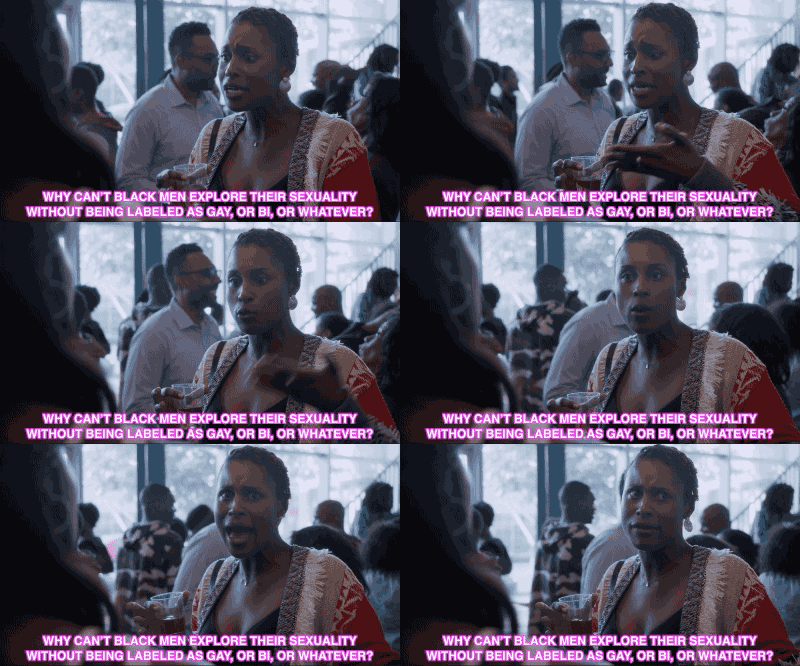
It’s fascinating to me that we are another decade into the 21st century and we are still rehearsing the same issues, making heteronormativity the predominant discourse in Black entertainment and casting anything outside of that identity as an aside or an issue to be managed. Is art imitating life? Have we not really progressed in these matters? Does this mean that shows that feature a queer or questioning character require an LGBTQ writer, executive producer, or showrunner? If the answer is “Yes” does that let cis-heteros off the hook and still susceptible to making the same mistakes?
It seems I have more questions than I have answers but I am not above wrestling with this as someone who consumes her fair share of television and as someone whose work is concentrated in sexual ethics. The matter of how Black male sexuality is represented on Black television and in Black culture matters. I believe this is a fair discussion to have in consideration of the proliferation of character-based programming coming at us from every angle and streaming service. If we are to persist in the production and consumption of this programming, we have to demand better representation of the stories of everyone and not allow heteronormativity to be the dominating framework.
And maybe there’s a possibility that these shows are actually setting us up well to have the discussions about sex and sexuality that our community sometimes like to avoid. If that is the case, it really is time we have a talk.
 A few days after my 35th birthday I went to King of Diamonds (KOD) my first real strip club experience–sorry little strip club on Bourbon Street with women dancing to Sixpence None the Richer’s “Kiss Me,” you don’t count. This trip to KOD was about a year and a half in the making as there were many attempts at going that failed. The first attempt occurred during a bachelorette weekend and failed because the concierge convinced us that there were better things to do. The second attempt happened during a close friend’s birthday weekend and failed because of the general exhaustion of the group. With this third attempt in view, nothing could stop me from being the one to conquer this beast. Despite having no real detailed plan for going because my friends sometimes like flying by the seats of their pants, I still had some hopes that on the last Monday in December I would end up in the nation’s largest, most popular black strip club. Fortunately the universe conspired with me and I made it. I didn’t suffer from sensory overload as some suggested I would, I didn’t try to save any of the women stripping, and I didn’t get bored quickly. So what DID I do? I had a good time but I think it was atypically so because I was in my head and analyzing everything I saw with my friends. So here are some of my thoughts from my night at KOD.
 I’m low-key scared of women who strip. So about my personal experience at the strip club…I will confess that I was somewhat scared of the women. My friends and I were sitting at the bar which was close enough to watch the women strip on the stage and really close to the women who were cruising for lap dances and VIP room action. Early in the night I broke a $20 into $1 bills so that I could tip the women. I was excited about my $18–because the club charges a 10% fee to break large bills–and I felt ready to tip women. I saw plenty that was worth “making it rain” but I never got up the nerve to leave my bar stool to leave a tip on the stage. I was scared that someone would find out I was there celebrating my birthday and then bring me up on the stage for a dance or put my face in their crotch or something else. For the women roaming I tried not to make eye contact in case they thought I was choosing that night and decided I was ready to be relieved of all my money. I’ll also admit that the thoughts of objectification were running through my head as I struggled with enjoying what I was seeing but not wanting to objectify women–even though I believe these women were exercising agency not being objectified. These strains of thought run deep and even if I’m able to articulate a progressive to liberal view of women who strip, deep down the problem still exists. As the kids say, “There are levels to this thing.” As you can see I was clearly in the strip club with a lot of preconceived notions about how it works and a lot of fear that these women were predators and not just performers looking to put on the best show for all patrons. So what did I do with all those $1 bills? I spent it at an IHOP. Don’t worry, I realize how ridiculous I am for this.
 Nicole Symmonds